
Douglas County S.A.V.E. Search
Nevada’s current official front end is Nevada S.A.V.E., short for Survivors, Advocates, Victims and Enforcement. Older state pages, brochures, search results, and the familiar VINELink name may still appear. Treat those as legacy references. Do not follow an old tutorial when it conflicts with the live Nevada service. S.A.V.E. operates through the Nevada Attorney General under NRS 228.205 and lists round-the-clock support at 866-393-5445.
The search is useful for a specific Douglas County person in custody or under supervision. It can bridge county and state systems, yet its own warning sets a firm limit: someone no longer in custody might not appear. A no-match is not a release notice. It may reflect spelling, an alias, the wrong custody system, a transfer lag, confidential or sealed data, or the platform’s coverage rule.
For Douglas County Jail custody, also use the official Sheriff app or call the jail. For a Nevada prison sentence, check NDOC. The federal Bureau of Prisons and ICE maintain separate locators, so S.A.V.E. does not establish release from those systems.
Search Douglas County Inmate Alerts
The live S.A.V.E. form uses one combined field plus a CAPTCHA. It accepts a full or partial name or an offender ID. For a name, enter first name and then last name. When spelling is uncertain, the page suggests the first three letters of the first name, a space, and the first three letters of the last name. More than one match requires care. Do not choose by a common name alone; compare only the lawful identifiers the current result provides.
- Open the current Nevada S.A.V.E. home page and complete its CAPTCHA.
- Enter the offender ID when known. Otherwise enter the full or partial name in the stated first-then-last order.
- If the full name fails, try the official six-letter fallback made from the first three letters of each name.
- Review possible matches and use available identifiers to select the correct person.
- Copy the status or event exactly as shown and record the observation date and time.
- Confirm release through the last known custodian before stating that the person left custody.
A miss should start a check, not end it. Verify the legal spelling, aliases, date of birth where lawfully available, and offender or booking number. Then decide whether DCSO, NDOC, BOP, or ICE was the last custodian. A Douglas County arrest may require the Sheriff app, jail call, court docket, and a focused DCSO release-record request. A state-prison case belongs in the NDOC offender search.
Note: S.A.V.E. may retain a valid registration and reactivate it if the person returns to custody, even after a name disappears from search.
Douglas County S.A.V.E. Results
Only the fields visible on the current matching record should be quoted. The research did not verify a released-result screen suitable for publishing, so no fixed county field inventory should be invented from another state’s VINELink site. Status text, event wording, notification options, and identifiers can differ by custodian. Keep the exact label and its time rather than translating it into a broader claim.
| Current item | How to use it | What it cannot prove alone |
|---|---|---|
| Name or offender ID | Match the intended person | Release or present location without status |
| Custody or supervision status | Quote the exact displayed words | A certified Douglas County release transaction |
| Event or notification | Record its wording and observation time | The reason for release or transfer |
| No matching record | Trigger spelling, system, and agency checks | That the person was released |
| Registration confirmation | Preserve the alert reference | That a later alert is an official NDOC record |
The difference between released and still in custody is crucial. A live DCSO or NDOC location can support current custody at the time observed. A release event can support a change, but it should be checked against the agency record. Silence cannot do either job. A transferred person may have left Douglas County custody while remaining confined elsewhere.
- Custody event
- A reported change such as release or transfer, stated in the platform’s own words.
- Notification
- An alert about a recorded event, not a certified government record.
- Transfer
- Movement to another custodian rather than return to the community.
- Discharge
- Formal end of a sentence or supervision, distinct from a temporary custody change.
Register Douglas County Release Alerts
S.A.V.E. says a notification may be requested with or without an account. Begin from the verified matching record and choose the available notification option. Select only channels shown on the live screen. The observed account form documented email as required, while SMS, telephone, and TTY were optional. It also offered separate after-hours choices for the period from 7 p.m. to 7 a.m.
- Open the correct matching record and choose its notification control.
- Select from the email, SMS, telephone, TTY, and after-hours options actually offered.
- If account creation is available, enter the required email and password, then choose a security question and answer.
- Complete the delivered verification and save the registration confirmation or support reference.
- Keep the registration if the person leaves custody and disappears, since S.A.V.E. says it may reactivate after a return to custody.
- For formal mailed NDOC or Parole Board notice, register through those agencies as a separate process.
As observed July 28, 2026, the S.A.V.E. account-registration screen said account creation was temporarily unavailable. That outage affects the account route, not the need to check the live screen for a no-account notification option. The form showed optional names, required email and password, optional alert channels, and security-question controls.
No PIN step appeared in the current web account form. It used a password and security question instead. Legacy VINE instructions may describe a PIN, but they must not be copied into the Nevada web process. A telephone PIN workflow should be stated only after a live call verifies it and identifies it specifically as a telephone registration step.
The captured official registration page documents the current controls and the temporary outage.
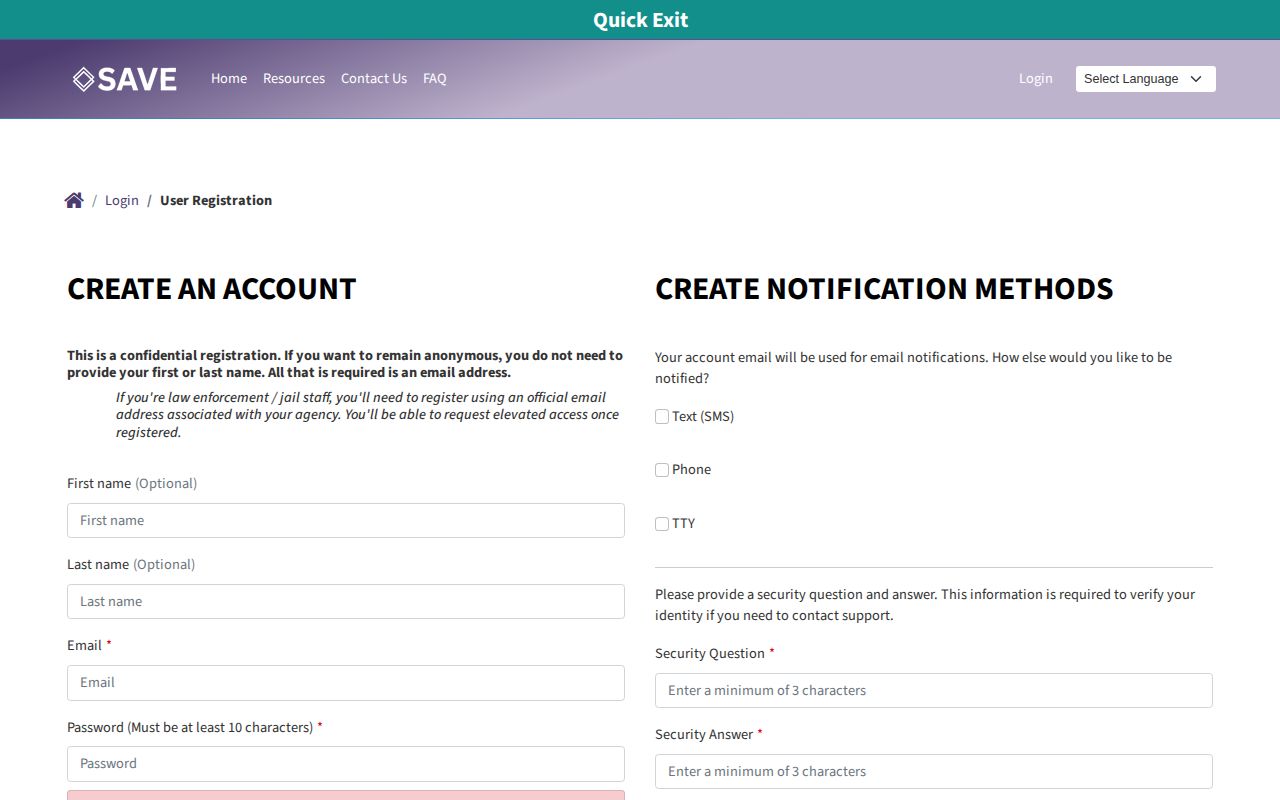
This screen supports the web registration facts. It does not establish a PIN requirement or a person’s release status.
Douglas County Official Notification Channels
S.A.V.E. is supplemental. The NDOC victim-notification program says its transmitted S.A.V.E. data is not audited first and is not an official NDOC record under NRS 179A.090. It also says the service does not replace official mailed notification from NDOC or the Nevada Board of Parole Commissioners. A person who needs that formal channel must follow the agency’s written registration instructions and provide the required offender and registrant information.
This separation prevents two common mistakes. First, an electronic alert should not be called a certified discharge record. Second, signing up for S.A.V.E. should not be described as enrollment in every NDOC or Parole Board notice. Maintain each confirmation separately. For help with S.A.V.E., call 866-393-5445 at any hour or email NVSave@ag.nv.gov; the service says email replies are expected within three business days.
The Nevada Sex Offender Registry is another distinct system. It covers a statutory subset of people who must register and can include someone living in the community. It is not a broad list of released inmates, does not include everyone convicted of an offense, and cannot prove the physical time a person left Douglas County Jail. Use it only when the person and legal category match.
Confirm Douglas County Release Alerts
Confirmation follows the custody system. For a Douglas County jail event, call Minden Jail at 775-782-9922 or the appropriate Jail Administration number, ask whether the person is still held, released, or transferred, and request the public release date, time, and destination. The official Sheriff app is the current roster route because the browser page says its inmate list is coming soon. An absence from either source remains weak evidence.
For a state-prison event, use NDOC’s individual search and separate Release and Parole data. NDOC warns that web information is raw and not an official record, so call Family Services at 775-977-5707 or request the official record when exact proof is needed. For parole, compare the Board’s monthly action with NDOC and field supervision. A parole grant may still await an effective date, plan approval, hold resolution, or processing.
Federal sentences require the BOP Inmate Locator. A possible immigration handoff requires the ICE locator and field-office confirmation. Neither is covered by a Douglas County VINELink label. The complete named-person fallback chain is available on the Douglas County released-inmate search.
In an urgent safety situation, contact law enforcement and appropriate victim services instead of waiting for any database. Automated systems can lag, omit records, or report a transfer without explaining where custody went. Preserve the alert, record when it arrived, and verify the event with the responsible office.
A careful event log can prevent later confusion. Write down the person’s lawful identifier, the exact S.A.V.E. words, the time of the alert, the time the source was checked, and the agency contacted for confirmation. Keep a transfer separate from a community release. If the custodian cannot disclose a destination, state that limit instead of filling the gap.
Douglas County court records may explain why custody changed even when an alert gives only the event. East Fork Justice Court, Tahoe Justice Court, and the Ninth Judicial District Court use separate search paths. A docket can show bail, dismissal, sentence, warrant, or a release order, though it may not show the moment jail processing ended. Pair it with the jail or corrections record.
Historical alerts also need context. A past release message does not prove the person remains out of custody today, since a later booking or return to supervision can occur. Run a fresh source check and preserve both records. If a valid S.A.V.E. registration remains active, its reactivation feature may help capture a later return to custody.