
Douglas County ICE Transfer Path
Douglas County’s local record can show that DCSO custody ended. If the destination is ICE, federal civil immigration custody may begin at the same handoff. That event is a transfer, even if the county system uses a release field to close its booking. Ask for release type and receiving destination instead of relying on the date alone.
The distinction matters because bond, time served, dismissal, or a court order may resolve the criminal detention basis while an ICE detainer changes where the person goes. The person may be moved outside Douglas County and outside Nevada. The ICE Online Detainee Locator is nationwide, while DCSO remains the source for the county departure transaction.
| Record | What it proves | What it does not prove |
|---|---|---|
| DCSO release entry | County custody ended at a stated time | Community freedom without destination |
| ICE locator match | Locator-covered ICE status | Complete immigration case history |
| ICE no match | No result under that search at that time | Release, removal, or lack of custody |
| Immigration court record | Filed proceedings and orders | Exact physical custody location |
Search the ICE Detainee Locator
Use the official ICE Online Detainee Locator. The strongest route uses an A-number and country of birth. ICE requires an exactly nine-digit A-number, so an eight-digit number must be padded with a leading zero. The biographical route uses exact first and last name plus country of birth, with date of birth optional.
- Confirm the spelling and country of birth from a reliable source. Use the A-number route when the identifier is known.
- Enter all nine digits for the A-number, adding one leading zero only when the source number has eight digits.
- If using the name route, try the exact recorded name and then a supported variation when aliases or name order may differ.
- Record the result wording and time checked. Do not publish unnecessary identity details.
- Call the relevant ICE office or detention line if the person is not found, recently transferred, or needs a location confirmed.
ICE does not display people under eighteen. Its official attorney resource says the locator covers current detainees and people released within the last sixty days. After that period, absence cannot resolve the outcome. Recent transfers may also take time to appear.
Douglas County 287(g) Transfers
DCSO entered a 287(g) Warrant Service Officer agreement in February 2025. The Sheriff says the model applies inside its detention facility to people already arrested and booked. ICE assesses immigration status and decides whether to place a detainer. Trained local officers can execute civil immigration warrants within the detention facility. DCSO expressly says this is not authority for community immigration sweeps.
This local fact supports a narrow, accurate description. DCSO’s criminal-jail release to ICE is a custodial handoff. It does not establish the outcome of the criminal case beyond the cited event, and it does not decide the immigration proceeding. The federal locator and ICE contacts address the next custody stage.
The policy is documented in the official DCSO 287(g) clarification.
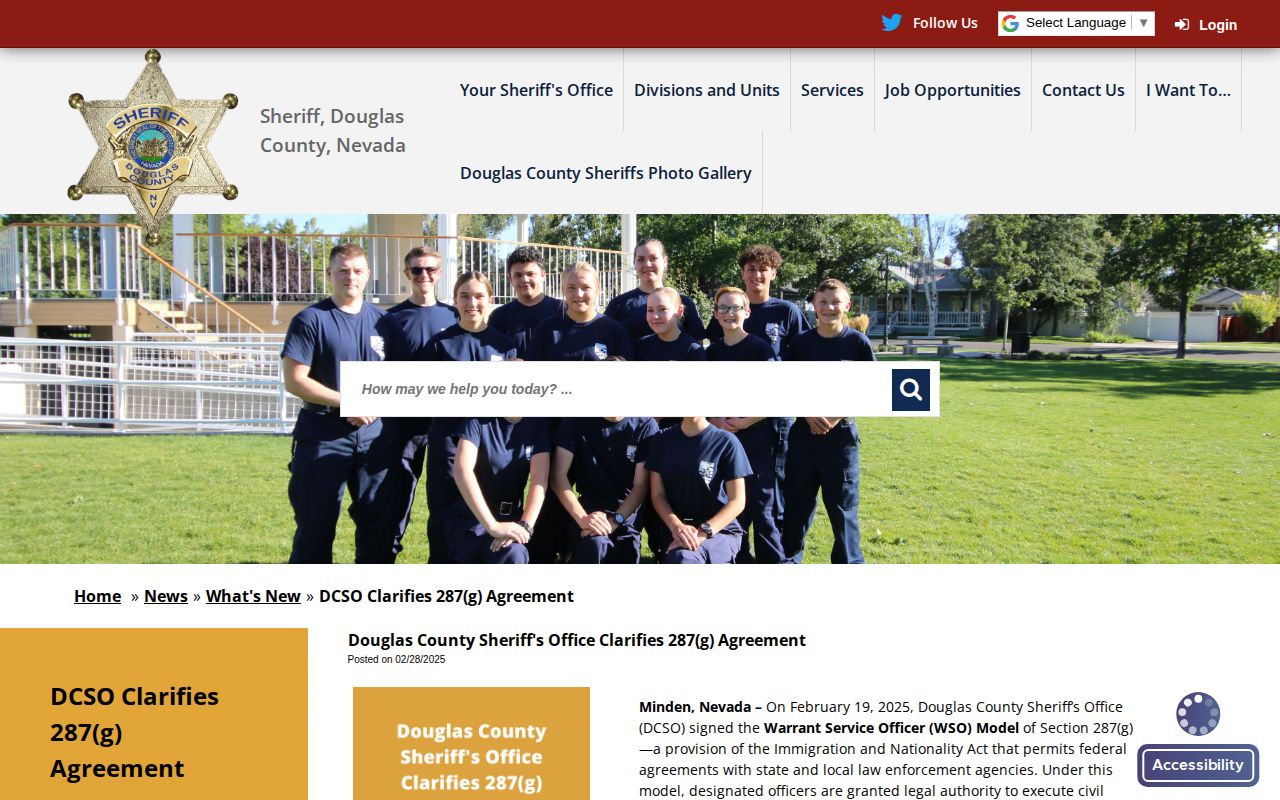
The source explains why the Douglas County destination field must be checked before a jail exit is called community release.
ICE Custody Contact Routes
The ICE Detention Reporting and Information Line handles detention questions at 1-888-351-4024. The researched hours are Monday through Friday, excluding holidays, from 8 a.m. to 8 p.m. Eastern. A relevant Enforcement and Removal Operations field office can also address location and case routing. Counsel may have additional case access.
ICE Detention Reporting and Information Line1-888-351-4024
Monday-Friday, excluding holidays
8 a.m.-8 p.m. Eastern
Nationwide immigration detention questions
Have the A-number, full name, country of birth, date of birth, and the last known DCSO booking details available. Share sensitive identifiers only with the verified official channel or counsel. Ask which facility currently holds the person, when the record was last updated, and which field office owns the case.
The locator does not provide a county-style release archive. If ICE confirms release, ask what official document or office can verify the date and type. If ICE confirms transfer, record the receiving facility. If the person was removed from the United States, use the exact agency description rather than calling that community release.
Request Douglas Transfer Records
DCSO Records can document the local side of the handoff. Request the booking sheet, custody chronology or release log, date and time Douglas County custody ended, release type, and receiving agency or destination if recorded and public. The Records office is at 1038 Buckeye Road in Minden, with mail to P.O. Box 218, Minden, Nevada 89423. Its number is 775-782-9933, and posted public hours are Monday through Friday, 8 a.m. to 5 p.m.
The DCSO records page permits in-person, mail, and email requests. For mail, include requester details, the case number if known, the individual’s name, a matching date of birth or Social Security number, and a stamped addressed envelope. Use the least sensitive identifier that will work. DCSO says it will call or email within five business days to verify availability, not necessarily complete production.
Posted one-dollar prices for criminal reports and name searches, with email copies free, do not establish the cost of an ICE transfer log. Ask for an estimate. Nevada law permits redaction of confidential material, but a requester can ask for the segregable public part and the legal basis for withholding.
The Douglas County Jail release route supplies more detail about the county transaction and the correct court check. Keep that local record separate from ICE’s federal custody record.
Read ICE Release Outcomes
Several outcomes can follow ICE custody. A person may be released under agency authority, transferred to another detention facility, remain detained while proceedings continue, or leave the United States under an order. The locator’s absence does not distinguish those paths. Obtain the official wording from ICE, counsel, or the immigration case record.
- Detainer
- An ICE request connected to taking custody when another agency’s detention ends.
- Civil immigration custody
- Federal detention under immigration authority, distinct from a criminal jail sentence.
- A-number
- The identifying number used in immigration records and the locator.
- Field office
- The ICE office responsible for enforcement and removal operations in a region or case.
A criminal case and an immigration matter can move on separate tracks. A Douglas County dismissal or bond event may end the local detention basis without ending ICE custody. Conversely, an ICE release says nothing by itself about a pending Douglas County court date or condition. Check each responsible authority.
Note: Use “released,” “transferred,” “removed,” or “not found” only when the source itself supports that exact event.
ICE, BOP, and USMS Differences
ICE civil detention is not BOP imprisonment. BOP holds sentenced federal prisoners and many former BOP prisoners appear in its locator. USMS often handles federal criminal defendants before BOP designation. ICE handles immigration detention. A person can move between systems, and one locator may be blank while another agency has custody.
If DCSO names USMS rather than ICE as recipient, use the federal criminal docket and Marshals route. If a BOP result says released, it does not rule out a later ICE handoff. If ICE shows a current detainee, it does not establish that the person ever served a BOP sentence. Agency names and dates in the underlying records keep the chronology sound.
Families and counsel should preserve the DCSO departure time, receiving agency, A-number or federal register number, locator observation time, and current facility contact. Those facts reduce confusion when a person moves quickly across jurisdictions.
Identity details can differ between systems. DCSO may record a name in one order while immigration files use another spelling, compound surname, or country-of-birth description. A failed biographical search should lead to careful verification, not guesses involving unrelated identities. Counsel or an official case document can confirm the A-number and recorded name. Keep those identifiers private except when sharing them with the verified agency, counsel, or an authorized family contact.
Transfer timing creates another gap. DCSO may finish its release entry before the ICE locator refreshes. Call the detention line when a recent handoff is documented but no result appears. Ask staff to verify the current facility and field office rather than infer release from a blank screen. Read the two records as a sequence, not as competing versions of one database.