
Nevada Prison Release Routes
A Douglas County defendant sentenced to state prison leaves the Douglas County Jail through transport to NDOC. That closes or changes the county custody event, but the person remains confined. NDOC can assign a person to any appropriate state facility, and the assignment can change. The agency’s May 2026 facility list identified no active correctional institution, conservation camp, or transitional-housing facility in Douglas County. Never infer the housing site from the sentencing county.
A later state-prison event can be parole, expiration, another release method, transfer, or discharge. Parole means the person leaves prison under community supervision before the sentence is fully discharged. Discharge means the controlling correctional or supervision obligation ended. An eligibility date is only a point at which parole consideration may occur. It is not a release promise. The completed NDOC release transaction and current status are stronger evidence.
| Event | Custody meaning | Official path |
|---|---|---|
| Douglas County to NDOC | State transfer, still confined | DCSO destination plus NDOC booking |
| Parole | Out of prison under supervision | NDOC, Parole Board, and P&P |
| Release transaction | NDOC confinement ended on recorded terms | NDOC Release data and confirmation |
| Sentence discharge | Sentence or supervision obligation ended | Formal NDOC or supervising record |
Search Nevada Release Records
The NDOC offender search accepts an exact offender ID or a demographic search by first and last name. The form identifies the percent sign as a wildcard. An ID is usually the cleanest match because names and aliases can overlap. NDOC warns that the portal contains raw data, is not error-free, and is not an official record. Its value is discovery and cross-checking, not certification.
- Search the exact NDOC offender ID when known. Otherwise use first and last name and review possible matches carefully.
- Open the matching profile and distinguish institution, sentence status, parole information, and completed release information.
- Check the downloadable Demographic, Alias, Booking, Parole, and Release data keyed to offender ID. Do not treat one dataset as the whole record.
- Compare hearing and decision information with the Nevada Board of Parole Commissioners when parole is involved.
- Contact NDOC Family Services or request formal records when the raw portal must be verified.
The official interface is shown in the captured Nevada offender-search source.
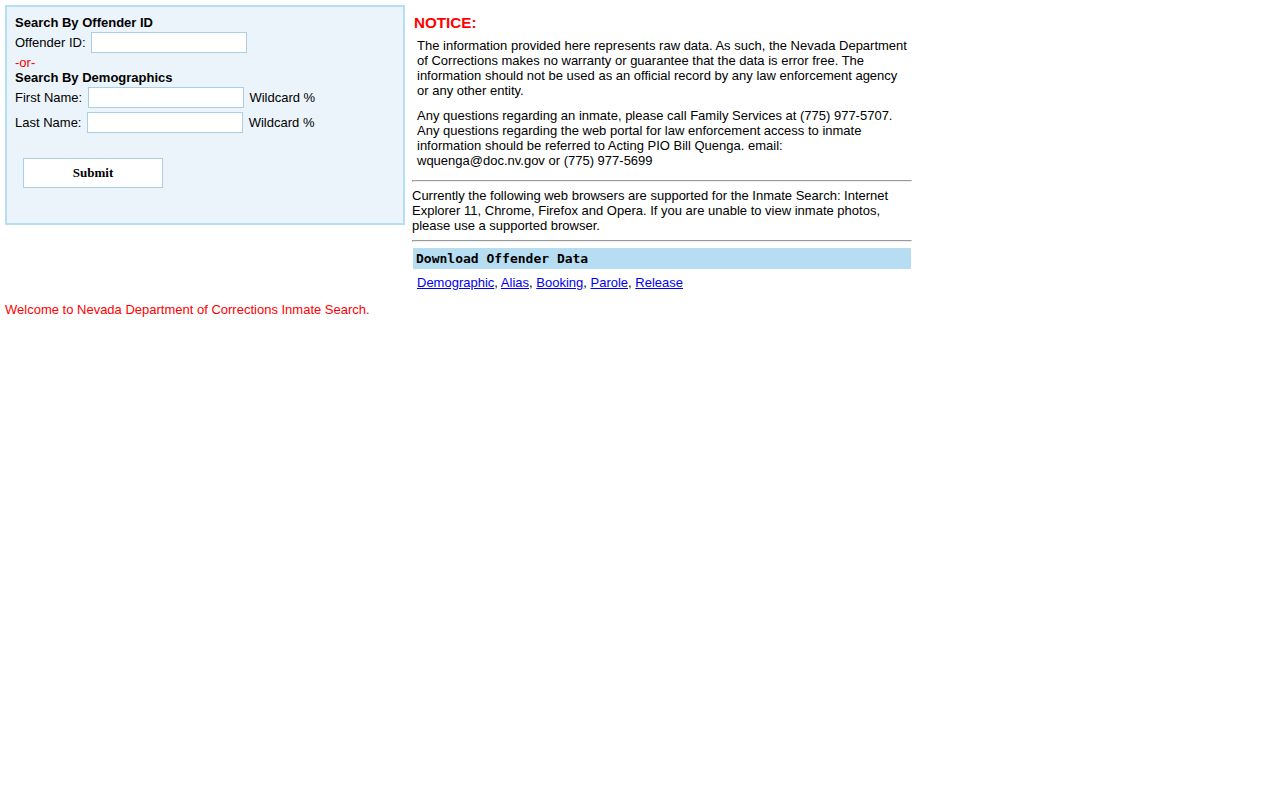
The screenshot confirms the statewide search route; it does not turn raw search data into an official discharge certificate.
Nevada Release Data Fields
NDOC publishes separate downloadable datasets. The Release file observed in the research contained offender_id, offender_book_id, release_date, and release_desc. The Booking file carried sentence dates and status, minimum and maximum components, sentencing county, sentence type, and start date. The Parole file exposed offender and book IDs, hearing date, and hearing location. These files can preserve historical rows after a county roster is gone.
Raw values need careful reading. A released demographic record can show the code INACTIVE-DSCHREL. A paroled profile may show institution PAROLE and sentence status “Paroled.” Preserve the source wording and verify odd codes instead of silently expanding or correcting them. Most important, do not equate parole eligibility, projected expiration, mandatory parole, or another planning date with actual release.
| NDOC source | Useful fields | Limit |
|---|---|---|
| Demographic | Offender ID, name, agency/location | Identity or location code may need confirmation |
| Booking | Sentence dates, status, county, term | Sentence planning is not physical release |
| Parole | Hearing date and location | Hearing does not guarantee release |
| Release | Release date and description | Raw row is not a certified record |
Nevada Parole Release Checks
The Nevada Board of Parole Commissioners decides parole. The Nevada Department of Public Safety, Division of Parole and Probation supervises people in the community. These are different functions. Board hearing calendars and Monthly Eligibility Lists show possible consideration. Monthly Parole Board Actions show results. Even a grant may await an effective date, approved plan, detainer resolution, or processing before physical release.
Use the Parole Board hearing page for schedules and the linked monthly actions for results. The Board warns that hearings late in a month may appear in a later report. It also publishes violation, condition-modification, lifetime-supervision, and early-discharge materials. A violation proceeding can return a person to custody or change supervision, subject to the final action.
Eligibility lists are generated by NDOC for scheduling and can change if the person moves institutions or becomes ineligible. “Granted,” “denied,” “continued,” and “rescinded” have distinct meanings. Copy the current action key rather than guessing from a calendar entry. For post-release reporting, use the supervising P&P office after release is confirmed.
- Eligibility
- The earliest lawful point for possible parole consideration, not a promise.
- Parole
- Community supervision during an unfinished sentence.
- Discharge
- Completion of the controlling obligation.
- Detainer
- Another authority’s hold that can delay or redirect release.
Nevada Release Records Contact
The offender-search page directs inmate questions to NDOC Family Services at 775-977-5707. The portal itself is expressly unofficial. When formal proof is needed, request the offender’s release history, time-computation record, parole or discharge documentation, and photograph if public from the proper NDOC records official. Provide the name, NDOC number, date of birth if needed, and a narrow date range. Ask for electronic delivery and an itemized cost estimate.
Nevada Department of CorrectionsStatewide correctional system
Offender search: ofdsearch.doc.nv.gov
Family Services: 775-977-5707
No active NDOC prison in Douglas County
Confidential medical, victim, security, juvenile, and other protected data can be redacted. Under Nevada public-records law, ask for the segregable public part and the statute supporting any withholding. NDOC time computation can be complex because judgments, credits, forfeitures, detainers, parole action, and amended orders interact. A portal date should not be restated as a guaranteed departure date.
The Nevada prison path differs from the Douglas County jail search and release record. DCSO confirms when county custody ended and where it went. NDOC confirms later state custody, release, parole, or discharge. Both records may be needed to reconstruct the full sequence.
Nevada S.A.V.E. Release Notice
Nevada S.A.V.E. is the current official notification and custody-search front end. Legacy VINE and VINELink instructions should be treated as historical. Search can use an offender ID or a full or partial name after CAPTCHA. The service warns that someone no longer in custody might not appear. No match is therefore not proof of NDOC discharge or release.
S.A.V.E. can provide timely status and notification evidence, but NDOC says it is supplemental, unaudited before transmission, and not an official NDOC record. Registration channels and availability can also change. Keep the alert and observation time, then verify the event through NDOC or the Parole Board. For support, S.A.V.E. publishes 866-393-5445 and NVSave@ag.nv.gov.
A person on parole may be outside prison yet still under state supervision. A released person may also have a court matter, detainer, or registration duty not resolved by the NDOC search. Check the system tied to the specific question rather than treating one status label as a complete history.
Douglas Commitments Statewide
Douglas County appears in sentencing data as the committing county, not as an NDOC housing location. A person may be reassigned across Nevada for classification, programs, medical needs, security, or release planning. Facility assignment can change before the offender profile or a third-party reference updates. Contact NDOC when a current location is material.
The county court judgment establishes the sentence. NDOC administers prison credits and release calculations under Nevada prison law. The Parole Board decides parole under Nevada parole law, and P&P supervises in the community. Each source should be cited for its own act. The clean sequence is judgment, NDOC admission, statewide assignment, parole or release decision, physical release transaction, supervision if any, and eventual discharge.
Formal confirmation can require more than public data. An amended judgment may alter the sentence, credits can be earned or lost, and a detainer can change the destination without changing the sentencing county. Compare the court’s current judgment with NDOC’s time-computation and completed release records. If they appear to conflict, ask the clerk and NDOC which version each office is using. Do not settle the conflict by choosing the date that looks most favorable or most recent on a search screen.
Note: A Douglas County sentence and an NDOC location code describe different facts and should never be used interchangeably.