
Douglas County Parole Versus Probation
Parole and probation are not two names for the same status. Parole is supervised release from a Nevada state-prison sentence. The Nevada Board of Parole Commissioners decides whether to grant it, while the Nevada Department of Public Safety, Division of Parole and Probation, called P&P, handles field supervision. Probation usually begins with a sentence from a court and can occur without an NDOC prison term. A Douglas County court judgment is therefore the core probation source. For parole, the NDOC record and Board action help establish the path from prison to community supervision.
The distinction matters when a name is missing from the Douglas County Jail app. That absence does not reveal parole or probation. A county detainee may have left on bond, completed time, moved to another custodian, or entered probation. A state prisoner may have been paroled, discharged, or transferred. Start with the last known custodian, then follow the record that created supervision.
| Point | Parole | Probation |
|---|---|---|
| Starting authority | Nevada Board parole action after a prison sentence | Sentencing court judgment or order |
| Main record trail | NDOC record, hearing material, monthly Board action | Court docket, judgment, probation order |
| Field supervision | Nevada P&P | Nevada P&P in the usual adult state path |
| End point | Discharge or expiration shown by an official record | Court or agency completion and discharge record |
- Parole
- Conditional community release from a prison sentence before final discharge.
- Probation
- A court-ordered community sentence subject to stated rules.
- Discharge
- Official completion or termination of supervision.
- Absconder
- A supervision status alleging loss of contact, not proof of a new offense.
Verify Douglas County Post-Release Supervision
A sound check uses more than one official channel. Search by an NDOC offender number when available because it is less prone to spelling error. For probation, identify the court that entered the judgment. Douglas County matters may be in East Fork Justice Court, Tahoe Justice Court, or the Ninth Judicial District Court, depending on place and case level. Ask P&P only for supervision information the agency may lawfully disclose. Do not treat the Parole Board as the field office, since the Board says it does not employ sworn supervision officers or enforce parole conditions.
- Open the NDOC offender search. Use the offender ID, or search first and last name with the permitted wildcard.
- Read the exact status, location, parole, and release labels. A parole row supports a timeline, but a future eligibility date is not a release.
- Review the Monthly Parole Board Actions for the decision month. A month-end hearing may appear in a later report.
- For probation, find the sentencing court docket and judgment. Confirm that probation was imposed and check later modification, revocation, warrant, or discharge entries.
- Contact Nevada P&P for the correct supervising-office route and any status it can release.
- When completion matters, request an official discharge or certificate instead of inferring it from silence in a portal.
The broader Douglas County release search and county-record path are covered on the home page. That route is useful when it is unclear whether the person ever entered state custody. NDOC covers Nevada prison commitments, not a Douglas County-only jail stay, federal custody, or immigration detention.
Douglas County Parole Decision Records
The Nevada Board of Parole Commissioners hearing page publishes monthly schedules and links to violation, condition-modification, lifetime-supervision, early-discharge, and results material. NDOC generates the Monthly Eligibility Lists used for scheduling. The Board warns that a person can be removed after an institutional move or an eligibility correction. Appearance on a list means possible consideration. It does not mean parole was granted.
Decision terms must be read from the current action key. A grant authorizes a parole path but does not by itself show the person crossed the gate. A denial means the Board did not grant release at that hearing. Continued or deferred means the matter moved. Rescinded means an earlier action was withdrawn. The monthly results page also warns that hearings held late in a month may not reach that month’s report. Record the report month, hearing date, decision words, and the time the source was checked.
The Board’s monthly calendar and result screens show why two documents are often needed. The eligibility list helps reconstruct scheduling, while the action report supplies the outcome. NDOC or P&P must still confirm release or active supervision. Nevada parole eligibility comes from the sentence and Chapter 213 rules, with offense-specific limits. There is no one safe formula for every sentence.
The official hearing interface can be reviewed in the image below. It is interface evidence, not proof of any one person’s present status.
View the Nevada parole hearing calendars at their official source.
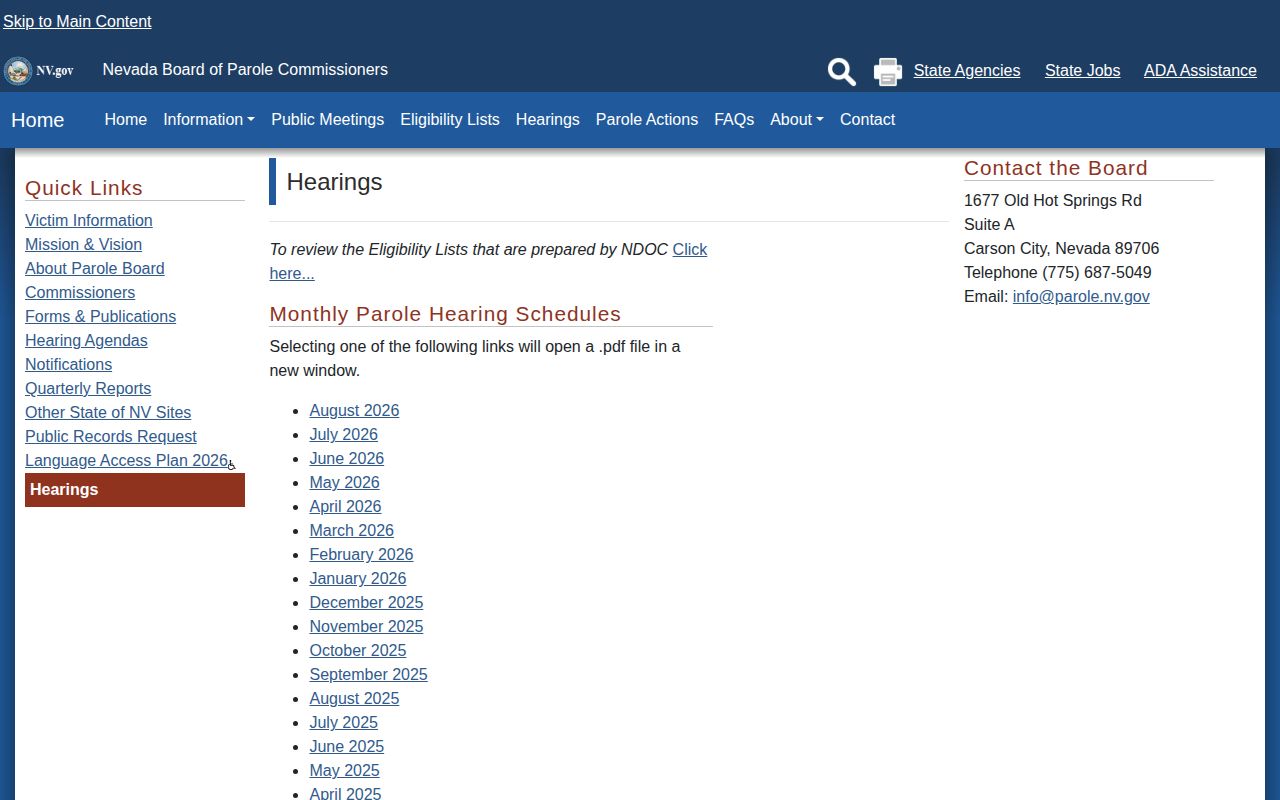
The calendar helps locate a proceeding; the later decision and custody records complete the Douglas County parole trail.
Douglas County Supervision Agency
Nevada P&P supervises people in the community and routes office questions. Its published division page is the proper starting point for an office assignment because the research did not verify a separate Douglas County field-office address safe to publish here. That limit should remain clear. A court clerk can explain how to access a probation order, and NDOC can clarify a prison record, but neither replaces the assigned supervision agency for field status.
Nevada Division of Parole and Probation
Official division and office contacts
Statewide Nevada supervision agency
Use the official directory for the current office route and hours.
The division page pictured below confirms the agency responsible for Nevada community supervision. Always use its current contact listing, since office assignments and public hours can change.
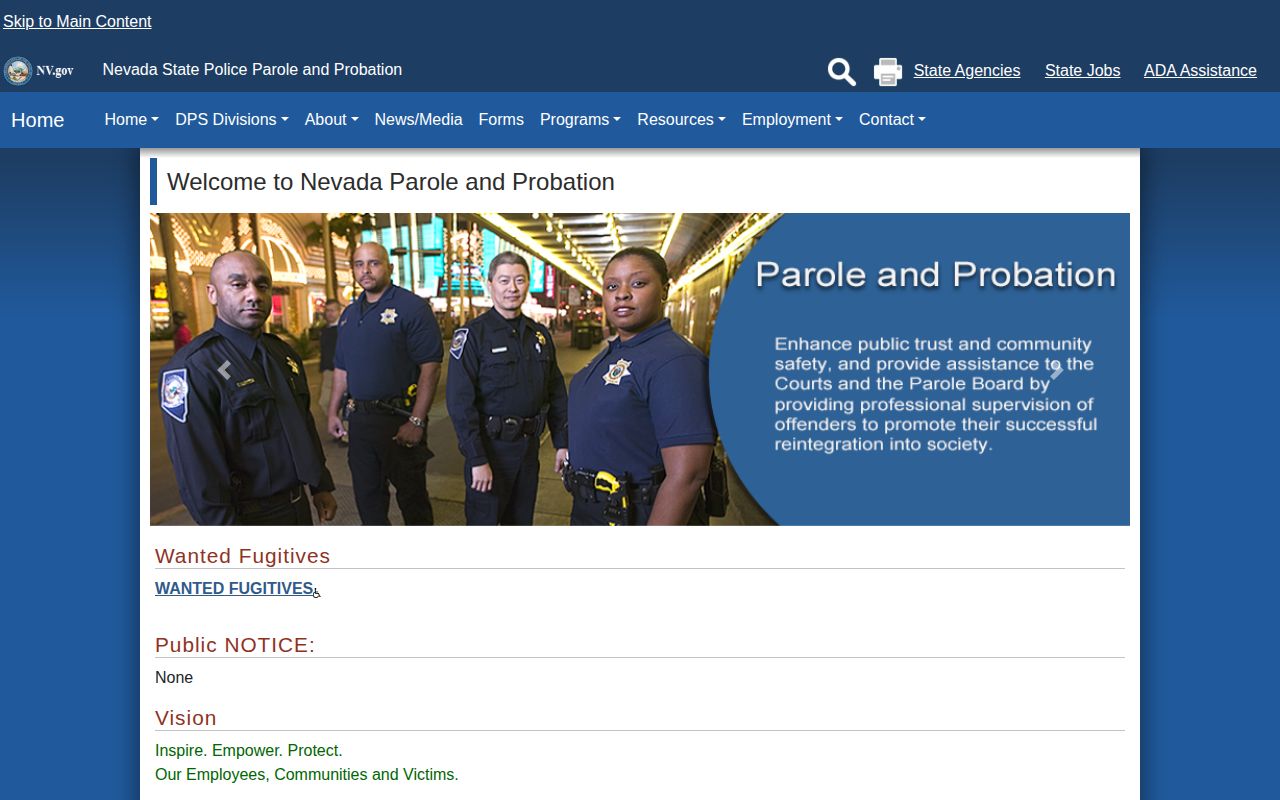
This state agency handles supervision. The Parole Board decides parole matters but does not serve as the field-enforcement office.
When asking about a Douglas County case, provide the full legal name, NDOC number if known, sentencing court, and observation date. Ask a narrow question: whether the agency can confirm active supervision, route contact to the assigned office, or explain how to request a discharge record. Staff may withhold details protected by law.
Douglas County Supervision Status Changes
Conditions are rules attached to parole or probation. They can include reporting, treatment, travel limits, payment obligations, or special terms in the actual order. The controlling list is the person’s Board, court, and P&P paperwork. A public summary should not be used to guess an individual condition. Modification materials on the Board site can show that parole terms were reviewed, while a court docket may show a probation modification.
An alleged violation can lead to a warrant, hearing, changed terms, continued supervision, or revocation. Revocation means the authority withdrew community supervision under the governing process. A warrant or absconder label is not proof of a new crime. It also is not a signal for private action. Confirm urgent custody or safety questions with law enforcement. The Board publishes a separate parole-violation route and says those hearings are generally held on Tuesdays, with women’s violation hearings usually on the third Tuesday.
Nevada S.A.V.E. may provide a custody or supervision event for a registered person, but it is supplemental. A missing result cannot establish discharge because the platform warns that people no longer in custody may not appear. Its data is not an official NDOC record. Court, NDOC, Board, and P&P records remain the stronger chain.
Note: Record exact status words and the date observed, because active, paroled, discharged, revoked, and released describe different legal or custody events.
Douglas County Supervision Discharge Records
Supervision ends through an official act or expiration recognized by the responsible authority. Completed parole is different from active parole. Likewise, a probation term in an old judgment does not prove probation remains open today. Look for a discharge certificate, satisfaction entry, court order, NDOC release or discharge record, or direct agency confirmation. A portal that stops displaying a person may reflect coverage limits, a data change, or sealing rather than completion.
Nevada public-record access starts with NRS Chapter 239. It favors prompt access to nonconfidential government records, but protected material can be withheld or redacted. Parole rules appear in Chapter 213, and prison discharge administration appears in Chapter 209. Ask for the specific public record and segregable portions. If the office lacks custody of it, request written routing or the expected response date allowed by the records framework.
A strong Douglas County supervision conclusion states the source, date, and limits. “Monthly action shows granted” is narrower than “released.” “Court judgment imposed probation” is narrower than “currently supervised.” “Official discharge certificate dated on a stated day” directly addresses the end of supervision. Keeping those claims separate protects accuracy and makes later corrections easier.
A sealed or confidential record may narrow what the public can see. That does not authorize a guess. Ask the record custodian for the nonconfidential portion and the legal basis for any withheld material. If a court docket and an agency record seem to conflict, note both observation dates and seek a current certified entry. Older search data may preserve a prior phase of supervision after a newer order changed it.
Douglas County supervision also should not be confused with present jail custody. A person held on a parole or probation matter may appear in a jail channel during detention, but the supervision record explains the authority and later outcome. Confirm the custody event and supervision event separately.