
Federal BOP Release Coverage
The Bureau of Prisons locator generally covers federal prisoners and many former federal prisoners from 1982 forward. It is nationwide. Douglas County is not a BOP facility or a filter that proves the person’s federal connection. A local arrest, federal prosecution, U.S. Marshals hold, prison designation, and later BOP release can occur in several places.
A historical result may state “Released” or “Not in BOP custody” and show a release date. Read that as a BOP confinement fact. The person may be on federal supervised release, in state or local custody, held by ICE, deceased, or outside the locator’s coverage. The status cannot establish what happened in an unrelated Douglas County booking.
| Federal stage | Likely source | What absence means |
|---|---|---|
| Recent arrest or pretrial hold | Federal court and USMS | BOP may not yet have a record |
| Sentenced and designated | BOP locator | Recheck identifiers and agency |
| Former BOP prisoner | BOP historical result | No match is not proof of no federal case |
| Community supervision | Federal court and probation | Outside BOP confinement can still carry duties |
Search Federal Release Records
Open the official BOP Inmate Locator. A number search accepts BOP register, DCDC, FBI, or INS identifiers. A name search accepts first, middle, and last name with optional race, age, and sex. Use the register number where known because similar names can produce several results.
- Select the number or name route and enter the most exact lawful identifiers available.
- Match the name and register number before relying on age, race, sex, location, or release date.
- Record the exact status wording and the date checked. Do not rewrite “Not in BOP custody” as “free.”
- Use the federal docket and USMS contact if the person is a recent defendant who may not yet be designated to BOP.
- Request formal BOP or court records when the locator’s brief result does not establish release method, destination, or supervision.
The official interface is captured from the BOP locator source.
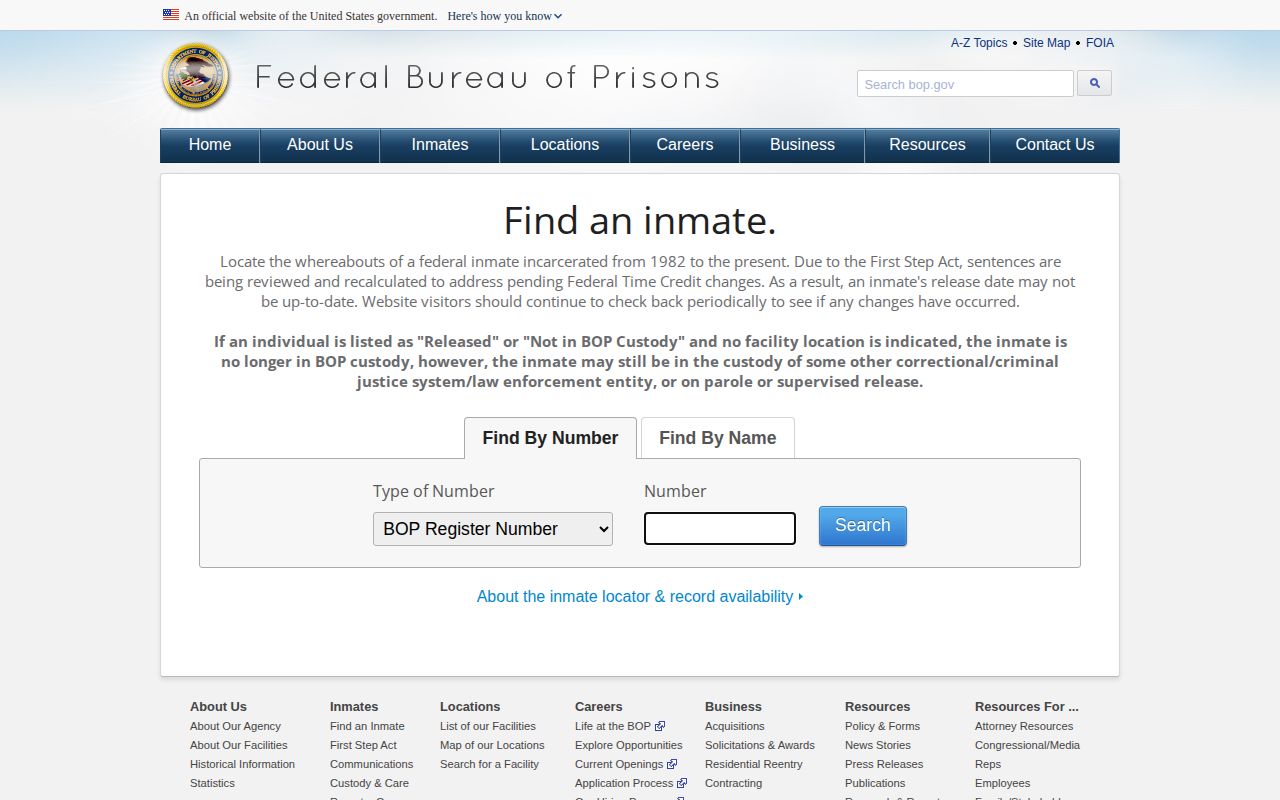
The locator provides a federal discovery path, while the agency record and court docket supply the broader release context.
Read Federal Release Results
BOP results show a compact set of fields: name, register number, age, race, sex, release date, and location or status. These help distinguish matches. They do not show every fact contained in a release packet. BOP’s BP-A0714 release form illustrates a fuller record with release method, institution, transportation or detainer agency, supervision jurisdiction and contact, proposed residence, and reporting obligation.
That gap matters. A date may reflect a completed release or a projected date that later changes. BOP warns that First Step Act calculations can affect projections. Court orders, earned-time calculations, detainers, and agency processing can also matter. Preserve the label the locator uses and confirm whether the date is historical or planned.
- Register number
- The BOP identifier used to distinguish a federal prisoner.
- Supervised release
- Federal court supervision after confinement, separate from BOP custody.
- Detainer
- Another authority’s request that may redirect the person at release.
- Designation
- BOP assignment to an institution after sentencing and intake.
Federal USMS Custody Gap
The U.S. Marshals Service holds many federal defendants before trial, after remand, and while they await BOP designation. It uses state, local, and private contract space. A person may therefore be physically confined without appearing as a current BOP prisoner. This is common enough that a blank BOP search must not be turned into a release claim.
Use the federal court docket to identify arrest, detention, remand, sentencing, commitment, and release orders. Then contact the appropriate USMS district office or counsel for the custody stage the docket supports. USMS does not offer a county-style recent-release feed. A court release order may precede transport and processing, so the order time is not always the physical exit time.
If Douglas County held the person under a federal arrangement, request DCSO’s custody chronology and receiving destination as well. The county record can show when local physical custody ended. It cannot by itself establish when the federal government later released the person.
Note: Local bed, federal legal custody, BOP designation, and federal supervised release are four distinct facts.
Federal Release Record Request
There is no Douglas County BOP release desk because BOP is a federal nationwide system. Begin with the locator and the institution named in the record. For a formal need, request the releasable federal custody and release documents from BOP or obtain the controlling judgment and docket entry from federal court. Give the full name, register number, date of birth when needed, and a narrow time range.
Federal Bureau of PrisonsNationwide federal prison system
Official locator: bop.gov/inmateloc
No BOP institution in the Douglas County facility map
Ask for the release date, release method, releasing institution, detainer or transportation agency, and supervision jurisdiction if those items are releasable. Avoid a broad demand that obscures the actual question. If the record is withheld or redacted, follow the federal agency’s stated review process.
Federal release evidence should not be substituted for the Douglas County jail release record. A person can have both histories, and the dates can mark unrelated custody events. Match the agency, register or booking number, case, and release description before connecting them.
After a Federal Release
A former BOP prisoner may begin federal supervised release under a U.S. Probation Office. Supervised release is ordered by the federal court and is not the same as Nevada parole or Douglas County probation. The person is outside BOP confinement but remains subject to the federal judgment. The docket and supervising office are the correct sources for terms and later action.
A detainer can change the release destination. BOP may transfer the person to state, local, or immigration custody rather than the community. The release form’s transportation and detainer fields are useful because a locator’s “Released” label may not describe that handoff. Check the receiving authority named in the formal record.
Death can also produce a no-longer-in-custody result and must never be described as routine release. Likewise, a location field can be a status label rather than a street address. Quote official wording, keep the observation date, and seek confirmation before drawing a broader conclusion.
Federal and County Distinctions
Douglas County Jail is operated by DCSO and handles county custody. NDOC administers Nevada prisons. BOP confines sentenced federal prisoners, while USMS often handles pretrial federal custody. ICE administers civil immigration detention. Each has its own locator and records office. One system’s no-match result says little about another.
A sound chronology may read: Douglas County arrest, federal transfer, USMS detention, federal sentence, BOP designation, BOP release to supervision or another agency, and later completion of supervision. Not every case has each stage. Build the sequence only from records, and keep release distinct from transfer and discharge.
BOP data are useful for reconnecting with a known person, confirming a historical federal custody event, or following a court matter. The agency and court should verify any date with legal or personal significance. Search results can change as calculations and records update.
Older federal records need a careful identity check. A common name, alias, changed name, or missing middle name can hide the right result or create a false match. The register number links the locator entry to BOP records, while the federal case number links it to the docket. Use both when available. Age, race, and sex are supporting descriptors, not a sound match by themselves. If the event predates the locator’s general 1982 coverage, an archival agency or court request may be needed.
A projected federal release date can move after sentence-credit calculations, a court order, or First Step Act changes. Keep the capture date and never present a future date as a guaranteed pickup time. For actual departure, seek the completed release record, releasing institution, and destination. When a detainer names another agency, continue the chronology with that custodian instead of stopping at the BOP release row.