
Douglas County Release Date Types
A court imposes the sentence, but the custodian computes the dates. Nevada indeterminate sentences commonly have a minimum and maximum term. Parole eligibility is the first point at which the Board may consider parole. It is not a promise. A projected expiration date is a calculation based on the maximum term and expected credits. Mandatory parole review, when applicable, follows its own statute. Only the completed release transaction shows that departure occurred.
| Date or event | Meaning | Does it prove release? |
|---|---|---|
| PED | Parole Eligibility Date, when Board consideration may first be possible | No |
| MPR | Mandatory Parole Review or release date in official explanatory material, subject to conditions | No |
| PEXD | Projected Expiration Date with projected credits applied | No |
| RRD | Raw NDOC sentence field; do not expand without the current NDOC definition | No |
| Release transaction | Historical event recorded after custody ends or changes | Yes, subject to event type and official confirmation |
A pretrial detainee usually has no sentence-based release date. Bail, a no-bail hold, a court order, dismissal, or later judgment controls that path. A sentenced county prisoner may have a jail computation. A person committed to NDOC has state sentence fields. Do not move a date from one system to another.
Find Douglas County Projected Release
Begin with the last known custodian. Douglas County Jail handles local detention and county sentences. NDOC handles a state-prison commitment even when the case began in Douglas County. A person transferred from the jail to NDOC did not return to the community at the county handoff. Federal and immigration custody use separate systems and do not share Nevada sentence-credit rules.
- Confirm whether the person is pretrial, serving a county sentence, committed to NDOC, or held in another system.
- For NDOC, open the offender search and use the offender ID when possible. Otherwise search first and last name with the supported wildcard.
- Read each date label exactly. Review the separate Booking, Release, and Parole data when the individual display is unclear.
- For a county sentence, obtain the judgment and ask Douglas County Jail for the current computation or releasable credit ledger.
- Check court amendments, holds, and the parole record before relying on an estimate.
- Record the source and observation date, then seek official confirmation when timing has legal importance.
The NDOC landing form does not itself display a field literally labeled “Projected Release Date.” It links distinct data sets and individual records. The exact current field must be verified on the result or download. NDOC also warns that the portal contains raw data, is not guaranteed error free, and is not an official record. Family Services at 775-977-5707 can clarify a record; an official time computation should be requested when exact proof is needed.
The official NDOC search screen below shows the correct state-prison starting point.
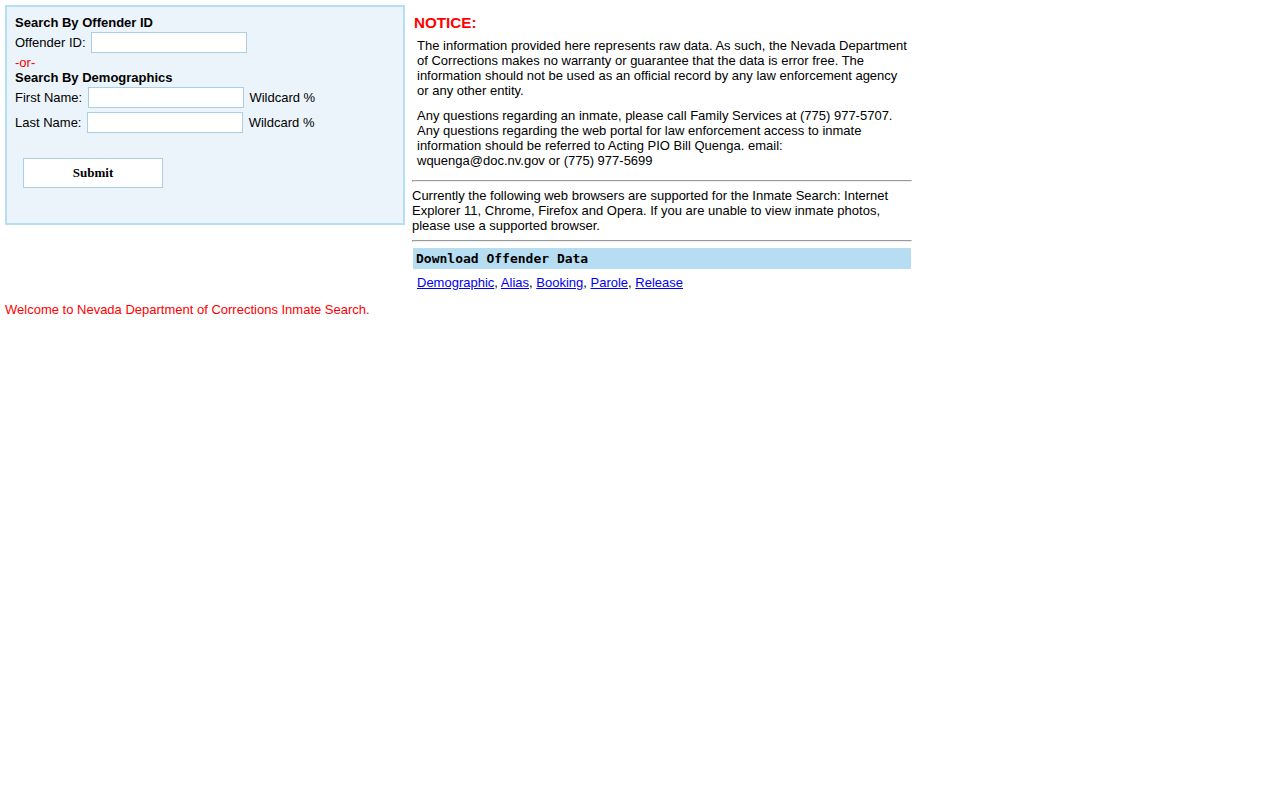
This state portal does not calculate a Douglas County-only jail sentence or a federal release date.
Douglas County NDOC Date Fields
NDOC’s public downloads are useful because they separate Demographic, Alias, Booking, Parole, and Release data. The Release file observed in the research contained offender ID, offender book ID, release date, and release description. Booking data contained sentence status, minimum and maximum parts, sentencing county, sentence type, start date, and the PED, MPR, PEXD, and RRD fields. Parole data included offender and book IDs, a hearing date, and a hearing location.
| Source data | Useful fields | Key caution |
|---|---|---|
| Booking | Sentence status, start date, minimum, maximum, PED, MPR, PEXD, RRD | Planning fields and sentence terms are not actual release |
| Release | Offender IDs, release date, release description | One release row may be one event in a longer history |
| Parole | Offender IDs, hearing date, hearing location | A hearing is not a grant or physical departure |
| Demographic | Identity and agency or location code | Raw codes need confirmation before interpretation |
A released demographic row may carry the raw code “INACTIVE-DSCHREL,” while a paroled profile may show institution “PAROLE” and sentence status “Paroled.” Those are source values, not interchangeable editorial labels. Quote them as observed and ask NDOC to explain any unclear code. When a profile has several sentences, never select the earliest date without knowing how concurrent and consecutive terms were aggregated.
Concurrent sentences run at the same time. Consecutive sentences run one after another. That distinction can change the controlling maximum and the way sentence credits affect an estimate. A public screen may not reveal enough to reconstruct the computation safely.
Douglas County Nevada Sentence Credits
NRS 209.4465 governs credits for many Nevada state prisoners, but the result depends on offense date, offense class, sentence structure, and exclusions. For qualifying conduct on offenses committed on or after July 17, 1997, the current statute provides a basic credit of 20 days per month. It also authorizes other possible awards for qualifying labor, study, education, programs, and exceptional service. These are possible credits. They are not a promise that every person earns every amount.
Educational awards may include 60 days for a GED or equivalent, 90 days for a high school diploma, 120 days for a first associate degree, and discretionary awards up to 90 days for further higher education. The statute also authorizes up to 10 additional days per month for diligent labor and study, up to 10 days per month for diligent participation in listed outside programs, and up to 90 days per year for exceptional meritorious service. NDOC Administrative Regulation 803 addresses the operational award process.
Credits ordinarily affect the maximum term and may affect parole eligibility where the law permits. Serious violent or sexual felonies, specified felony DUI offenses, category A or B felonies, and other listed offenses face limits on reducing the minimum term. For qualifying offenses committed on or after July 1, 2014, subsection 9 caps a minimum-term reduction at 58 percent. The Legislature enacted a successor credit framework effective July 1, 2027. It must not be applied early to a date computed under the July 2026 law.
Nevada does not have a universal rule that every state prisoner serves 85 percent. That shorthand belongs to a different federal framework and must not be imported into a Douglas County or NDOC calculation. Nevada sentence ranges are sometimes described through the minimum-to-maximum relationship in NRS 193.130, but that is not a substitute for the controlling offense, judgment, and credit law.
Note: Credit rules are sentence-specific, so a public estimate should never add every statutory award or assume the minimum term can always be reduced.
Douglas County Parole Timing
NRS 213.120 generally addresses ordinary eligibility after the court-imposed minimum for prisoners covered by its date rule, with other statutes and offense limits layered on top. For an eligible Nevada sentence of at least three years, NRS 213.1215 generally describes mandatory-parole timing at 12 months before the reduced maximum, subject to its conditions and exceptions.
The Board can deny mandatory parole under the governing statutory and public-safety framework. A grant can still await an effective date, an approved plan, detainer resolution, and release processing. The NDOC timekeeper, not the public website or the Parole Board, performs the controlling sentence calculation. Monthly Eligibility Lists are scheduling aids produced by NDOC. The Board warns that a person may be removed after a transfer or an eligibility correction.
Use the Board’s monthly action report to see the actual decision. Granted, denied, continued, deferred, and rescinded have distinct meanings. Even “granted” is not the same as “released.” The Douglas County probation and parole page explains how Board decisions differ from field supervision and discharge.
Douglas County Jail Release Calculations
A county-jail term does not use the NDOC public date fields. NRS Chapter 211 contains county-prisoner credit authority, including NRS 211.310 and related provisions. The sentencing judgment, jail credit ledger, disciplinary forfeiture or restoration, holds, and actual processing determine the result. No official Douglas County public sentence calculator was verified.
No verified Douglas County weekend-advance-release policy was found either. Do not count calendar days and assume an exit time. Call Douglas County Jail or request the computation. For a pretrial person, the question is different because there may be no sentence date to calculate. Bail status, a no-bail hold, court action, and another agency’s detainer can control custody.
A court release order can precede physical processing. Bond can be posted while another hold remains. Transfer to NDOC, another county, treatment, or ICE is not return to the community. Ask the jail whether the person remains in Douglas County custody, was released, or was transferred, and seek the public event date and destination when available.
- Detainer
- A request or authority that can keep a person held for another agency.
- Time served
- A sentence satisfied by custody time credited under the controlling judgment and law.
- Forfeited credit
- Previously available time credit lost through the authorized disciplinary process.
- Restored credit
- Forfeited credit later returned under the governing rules.
Douglas County Release Date Changes
A projected date can move for lawful or corrective reasons. Credits may be earned, withheld, forfeited, or restored. A court may amend a judgment. Staff may correct concurrent or consecutive structure. The Parole Board may defer or rescind an action. A new hold can prevent community release. Source data can also be corrected after an error is found.
| Change | Possible effect | Best confirmation |
|---|---|---|
| Credit award or loss | Moves a projected expiration or eligible date | NDOC time computation or county credit ledger |
| Amended judgment | Changes sentence terms or credit direction | Filed court order plus custodian update |
| Concurrent or consecutive correction | Changes the controlling aggregate term | Judgment and official computation |
| Parole decision | Grants, denies, delays, or withdraws a parole path | Board action and NDOC release status |
| Detainer or new hold | Prevents community release or causes transfer | Custodian and receiving agency |
| Data correction | Changes a public portal field | Official record from the source agency |
The final check should state the observation date and the precise field. “PEXD shown as of a given date” is a bounded claim. “Will be released” is not. A later actual event may appear in the NDOC Release data, a Douglas County jail record, or another custodian’s record. For ongoing custody-change alerts, Nevada’s current service is explained on the VINELink Inmate Search page.
When the date matters for a court or official process, obtain the filed judgment and the custodian’s current computation. Public portals are valuable discovery tools, but NDOC expressly says its online data is raw and not official. That warning should travel with every estimate.